

Every level of Twist & Roll shows its solved state for a second or two, then visibly scrambles. Twist & Roll is a mixed-reality puzzle game for Meta Quest 3, Quest 3S and Quest Pro, where you hold a 3×3×3 maze cube in your own room, seen through passthrough. We built its play around two moves: twist the cube’s outer faces to connect the grooves, then tilt the whole cube so gravity rolls the marble into its destination.
That destination is the glowing “eye”, the goal where the marble must go. Each level has a proven minimum number of turns, and matching it earns gold, the grade for solving in that minimum. Finding a route in so few turns is the challenging part.
Hold the cube with one hand, twist with the other
The first hand that grips the cube holds it, 20–30 cm in front of you. Your other hand grips a face and twists it. The face follows your wrist one to one, which makes the controls intuitive. A turn commits at 15°: a glow on the layer’s seam builds as you twist and flashes when the turn commits. This visual effect marks the completed turn. Bands on your wrists show which hand holds and which twists. Levels 1–5 teach this with ghost-hand demos instead of text, and Help → Hands replays them.
Watch the puzzle before it scrambles
You get 1.5 seconds to look at the solved state, or 2 seconds on a stage’s first level. Then the cube visibly scrambles, and pings show you the goal and the marble.
If the eye sits on a face turned away from you, a violet cone points to it, and a marble behind walls shows as an outline. That outline effect keeps the marble visible in places the walls would hide.
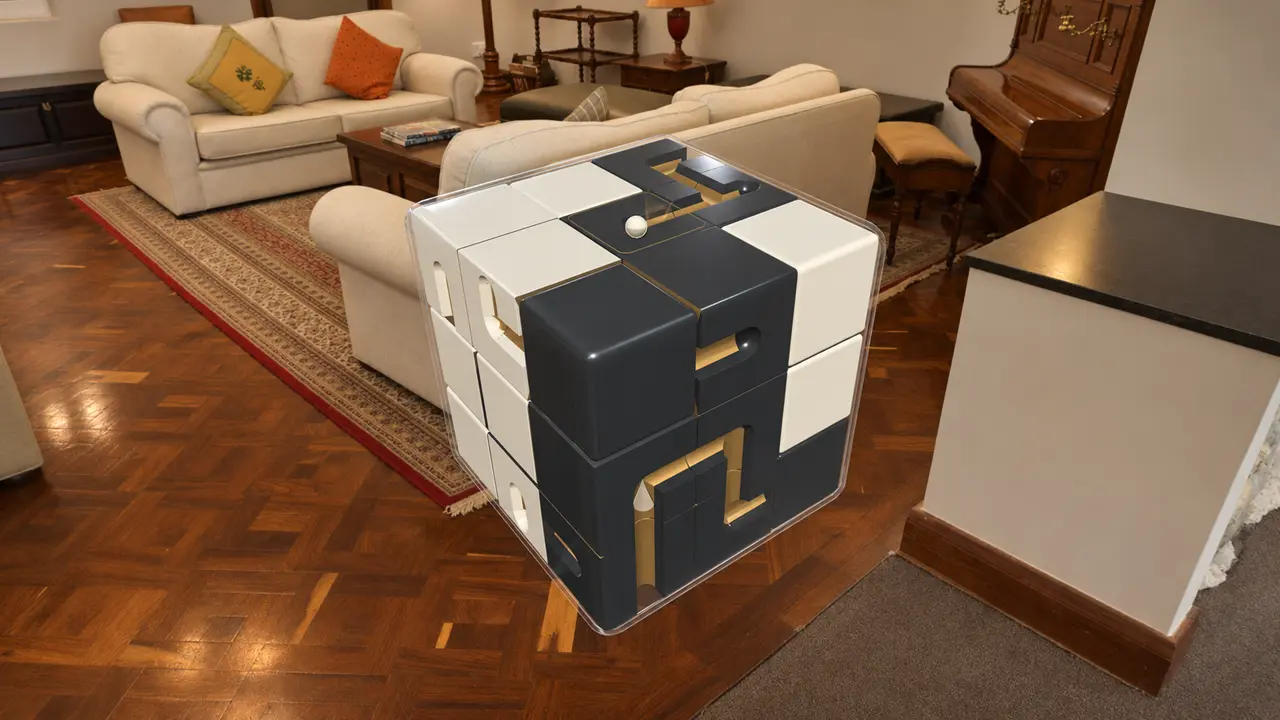
Turn a face to reconnect the grooves
All six outer faces can turn, and each move is a quarter turn: one face rotates a quarter of the way around.
You don’t turn the middle slices, and there are no half-turn moves. Every outer face is always turnable, so you can work on whichever face you need as you rebuild the route.
Look at the places where a groove stops at the edge of a face. Turning that face changes which grooves meet across the join. Your task is to find the arrangement that gives the marble a connected way toward the eye.
A useful way to approach each move is:
- Find the groove the marble can follow from its current position.
- Look for the next connection that route needs.
- Turn an outer face to bring the grooves together.
- Tilt the cube to roll the marble along the connected section.
A marble in a turning layer rides along with it. Keep that in mind when choosing a face: the turn can change both the groove connections and the marble’s position.
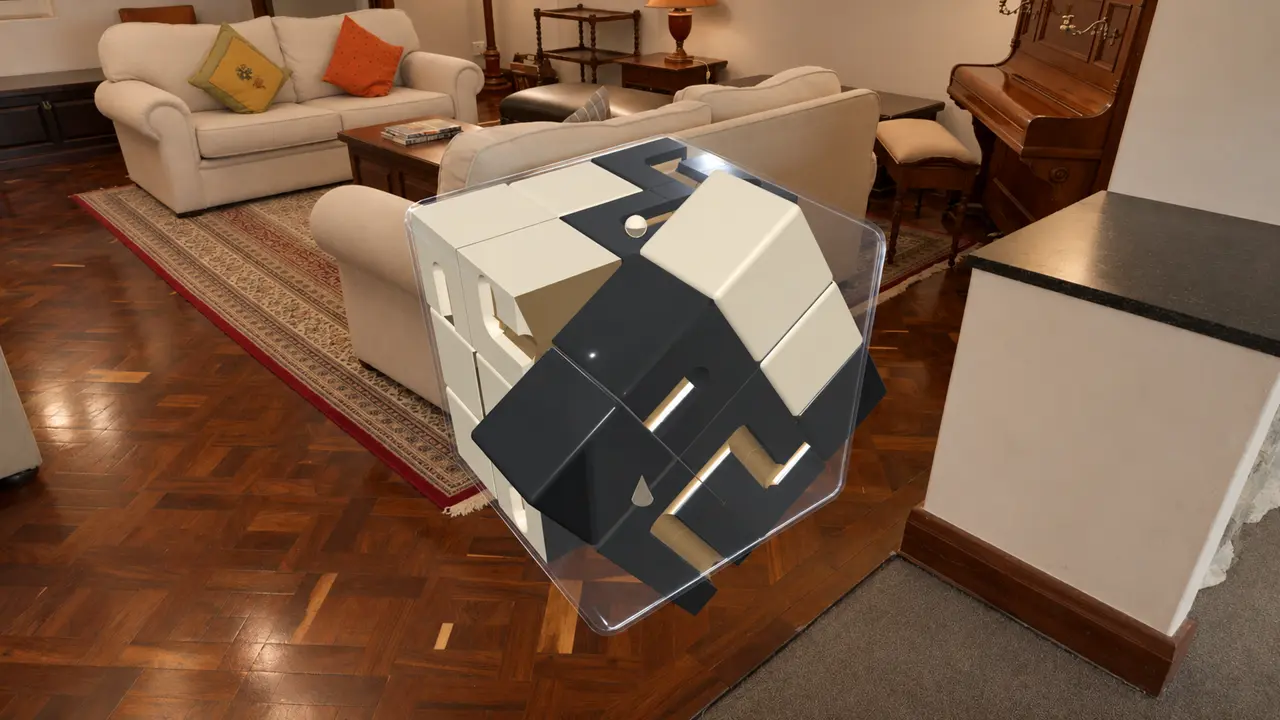
Tilt the whole cube to roll
Turning a face rearranges the maze. Tilting the whole cube lets gravity move the marble through it. These two mechanics make the basic play easy to learn: turn to connect the route, then tilt to roll.
Once you’ve connected a section of groove, look at the direction it runs. Tilt the cube so the marble can roll along that section. If the route changes direction, think about how the cube needs to face for gravity to carry the marble onward.
Take your time with the route
There are no timers, scores or numbers on display while the marble is live, and no speed pressure. That leaves room for a relaxing session, with time to puzzle over the grooves and decide which face to turn. The stage music stays calm, at 76 beats a minute or slower.
When a level ends, its card shows your TURNS, the turns you used, against MINIMUM, the proven fewest turns, and a grade: gold for the minimum, brass for one turn over, bronze for more. If a friend plays, tell them your TURNS for a level and see whether they can match its MINIMUM. Undo, which reverses a turn, counts as a turn.
If you’re stuck, pinch and hold the eye for 1 second, or tap Menu → Hint to see the single best next turn: a green ring on that layer’s seam and a glass ghost of the layer already turned. Hints are free and unlimited, and they’re listed on the level-end card. Tapping the eye uses Show goal, which is also free. Tell a new player: tap the eye to see the goal; hold it for a second to see the best next turn.
Follow the route through new levels
The campaign has 100 handcrafted levels in 10 stages: Seam, Ring, Constellation, River, Moon, Fall, Lamps, Garden, Dance and Lantern. Each stage gives the cube a new look and adds a mechanic: in Stage 6, a one-way edge the marble can pass in only one direction, and in Stage 9, two marbles that move one at a time, each to its own eye. You play Stage 1 in order; after that, the next stage opens when you’ve finished 60 % of the current one.
It’s single-player, played with your hands in your own room on a VR headset. There’s no locomotion: you stay where you are and the cube comes to you. A quick session is 5–10 minutes. A tea break is enough for a quick session, and with no speed pressure you can spend it puzzling over one route.
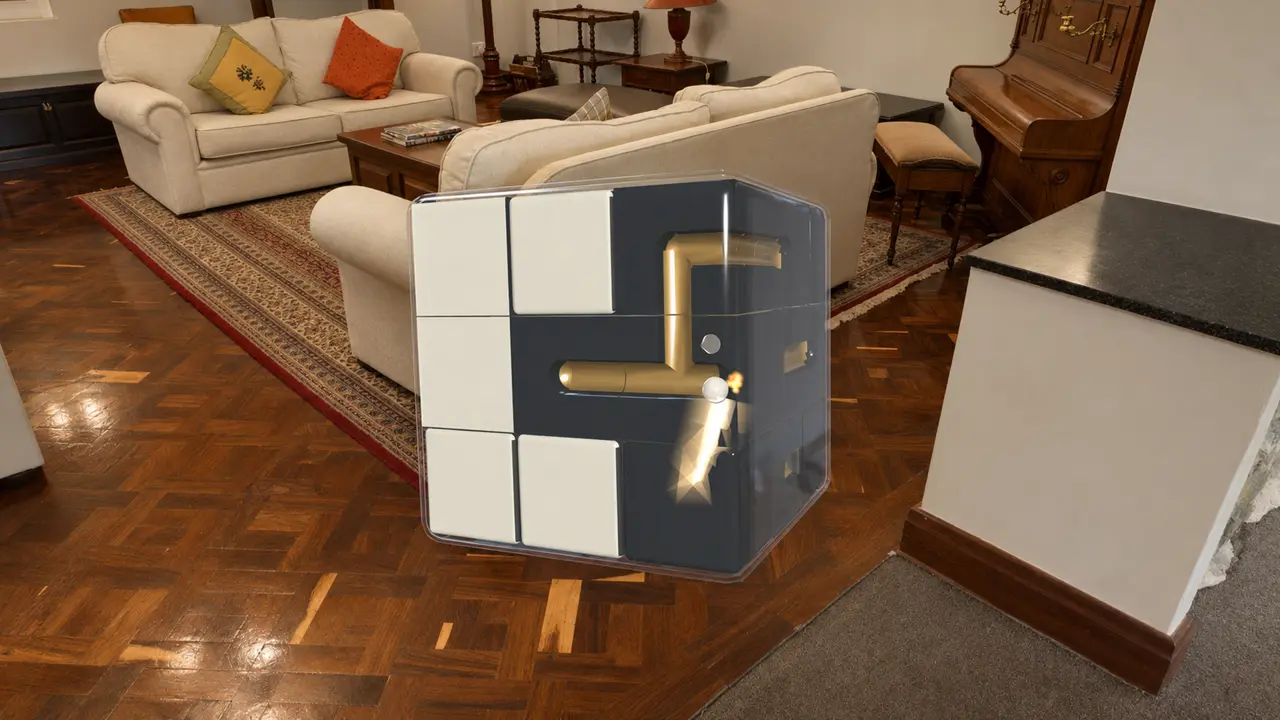
From Level 6, launching the game opens your cube exactly where you left it. Pick it up, make the turn that joins the last groove, tilt, and watch the marble roll into the eye.
